· ReadyStack
Worked example
Real numbers from this tool, line by line.
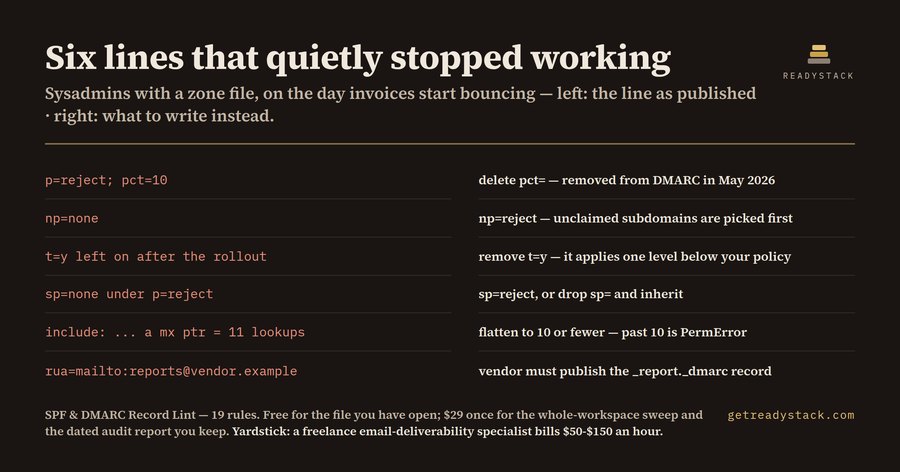
Six findings in one four-record zone file — the kind a platform engineer keeps in git and edits twice a year, on the afternoon a seventh sending vendor is added.
The zone is plain: one SPF record for the mail host, one for a legacy sender, one DMARC record, one DKIM selector. Every line is valid. BIND loads it, dig prints it back exactly as written, and a language model asked to review it will say it looks fine. Run 15 checks over it and six things are wrong: four errors and two warnings.
The SPF record needs 11 DNS lookups. RFC 7208 §4.6.4 caps SPF evaluation at ten DNS lookups — include, a, mx, ptr, exists and redirect= each cost at least one, and every include: resolves to a record that can spend more. At lookup eleven the receiver stops and returns PermError. Most receivers treat PermError the way they treat a domain with no SPF record at all. If your DMARC was passing on SPF alignment alone, DMARC fails with it. Nothing in the editor turns red, nothing in the deploy log turns red, and the record stays live until somebody notices invoices landing in spam.
Eight includes, an a:, an mx and a ptr: is eleven. Nobody adds eleven at once: you add the fourth vendor, then the sixth, then the eighth, and the record crosses the line on an ordinary Tuesday.
The ptr mechanism is still in there. RFC 7208 §5.5 says it is deprecated and must not be published: receivers are free to ignore it, and it costs a lookup per candidate host on the way.
A legacy sender ends in +all. That authorises every host on the internet to send as the domain — the same protection as publishing nothing, with the paperwork of publishing something.
The DMARC record is p=none with no rua=. p=none satisfies the sentence "the domain has a DMARC record" and blocks nothing at all. Without rua=, no aggregate reports are ever sent anywhere, so there is no data to move off p=none with. It is monitoring with the monitor unplugged.
The DKIM selector has an empty p=. An empty public key in a DKIM record means the key is revoked: every signature made with that selector fails, and mail signed only by it has no DKIM at all.
Fix those six and the same zone returns zero findings.
Why the free checkers do not catch it
Because they resolve. Every online SPF tool takes a domain name, queries DNS, and answers about the record already live — which is exactly the record already costing you mail. The one you want checked is in a pull request, on a domain that does not resolve yet, behind a Terraform variable. A chatbot will count your include: chain by guessing.
SPF & DMARC Record Lint reads v=spf1, v=DMARC1 and v=DKIM1 strings wherever you actually write them — BIND zone files, aws_route53_record and cloudflare_record blocks, Kubernetes and Ansible YAML, .env files, docs — and runs 15 checks on each one: seven for SPF, five for DMARC, three for DKIM. Findings land on the line in the Problems panel with the RFC section and the edit that fixes them. No DNS queries, no network, no account, no telemetry.
The file in front of you is checked in full, by all 15 rules, free and forever, with nothing timed or watermarked. The licence key is a different axis: sweeping every zone, Terraform and YAML file in the workspace in one pass, and keeping one dated Markdown audit report you can attach to the change ticket. $29 once, one key per person or CI seat, 7-day full refund — against the $50–$150 an hour a freelance deliverability specialist bills, most of the first hour going on reading the records you already have.
15 seconds — what it actually does
Questions people ask
What does SPF & DMARC Record Lint actually do?
It reads the SPF, DMARC and DKIM records where you write them — BIND zone files, Terraform cloudflare_record blocks, Kubernetes YAML, .env files — and runs 19 checks on every v=spf1, v=DMARC1 and v=DKIM1 string. It counts SPF DNS lookups itself, so you see the number before the record is published, with no DNS query and no network call.
Who is it for?
Sysadmins and platform engineers who own a zone file, and deliverability consultants who audit other people's. If you have ever added one more include: to an SPF record, or published p=reject with pct=10 and assumed it was a ten percent experiment, this is written for you. It also fits a compliance owner who has to show that enforcement was on.
Why not just use a free online DMARC checker?
Online checkers resolve live DNS, so they can only judge a record after you publish it — the damage is already out. This runs on the text in your branch, before merge, on a domain that need not resolve. Most were also written against RFC 7489 and still call pct= valid, which RFC 9989 removed in May 2026.
What is free and what needs a licence?
The file you have open is checked in full, free, forever: all 19 rules, every finding, nothing watermarked or timed. The licence covers the workspace sweep — every zone, Terraform and YAML file in the folder in one pass — and the dated Markdown audit report it writes out for you to keep and attach to a ticket.
What would this cost me otherwise?
A freelance email-deliverability specialist bills 50 to 150 dollars an hour, and the first hour goes on reading the records you already have. The licence is 29 dollars once, one key per person or CI seat, with a 7-day full refund. One rejected invoice run costs more than either.
Ask about this tool
One question, answered by the person who built it. Your email only if you want the answer sent.