opening range breakout journal: what the stop costs before the breakout: contracts for your risk cap, micros, R targets and prop daily loss limit
Opening range breakout journal: type the range high and low, get the dollar risk of the stop, contracts that fit your cap, micros, targets and a trade log.
Example of the result this page gives you
Example (made-up, exactly as in the file): 2 NQ contracts on a 60-point opening range with the stop at the other side lose $2,408.00 when the stop is hit, $1,908.00 over the $500.00 cap per trade and more than the whole $1,500.00 daily loss limit; 4 MNQ on the same range lose $496.00.
Example (made-up, exactly as in the file): 2 NQ contracts on a 60-point opening range with the stop at the other side lose $2,408.00 when the stop is hit, $1,908.00 over the $500.00 cap per trade and more than the whole $1,500.00 daily loss limit; 4 MNQ on the same range lose $496.00.
A printed ORB journal asks you to do the position-size maths by hand before the breakout; this one does it from the opening range high and low you type, with the CME dollar value per point of ES, NQ, MES and MNQ, and shows the micro size that fits when even 1 contract is too big. Type your own range below; the answer updates as you type.
Your numbers
Your ORB trade plan
Opening range (points)
60
Risk per contract if the stop is hit ($)
$1,204.00
Risk at your planned size ($)
$2,408.00
Loss above your cap if this stop is hit ($)
$1,908.00
Stop-outs at your size before the daily loss limit
0
Contracts that fit your cap
0
Micro contracts that fit your cap (MES = ES/10, MNQ = NQ/10; same commission)
4
Risk of those micro contracts ($)
$496.00
Long target above the range high (points)
21,632.5
Short target below the range low (points)
21,332.5
Reward per contract at the target, after commission ($)
Everything updates as you type. Nothing is uploaded. This runs in your browser.
Why the opening range decides your loss before you click
What you lose: with the stop at the other side of the range, the stop distance is the range itself. On NQ every point is $20 a contract, so a 60-point range costs 60 × $20 + $4 = $1,204.00 per contract. In the made-up example 2 NQ risk $2,408.00: $1,908.00 above a $500.00 cap, and one stop is more than a $1,500.00 daily loss limit. If that limit belongs to a prop-firm account, its rules say what a breach costs you.
The size that fits: 0 NQ fit a $500.00 cap on that range; 4 MNQ do (4 × (60 × $2 + $4) = $496.00). The widest range where 1 contract still fits is (cap - commission) / $ per point: ($500.00 - $4.00) / $20 = 24.8 points on NQ, 9.92 on ES.
What the journal shows (made-up example log, 20 trades): the 11 trades on ranges within the max width made $4,071.50; the 9 on wider ranges lost $10,521.50; 2 days broke the $1,500.00 daily loss limit. Net -$6,450.00. The wide-range rule is the one line that would have changed the month.
Contract values used: ES $50 a point (tick 0.25 = $12.50) · NQ $20 (tick 0.25 = $5.00) · MES $5 (tick 0.25 = $1.25) · MNQ $2 (tick 0.25 = $0.50), from the E-mini contract table on Wikipedia, which cites CME Group, read 15 November 2026.
Compared with: a printable first-hour range journal (30 daily pages, position-size formula done by hand) is $9.00; an 8-article ORB package with no calculator is $27.60; a general journal subscription such as TradeZella Essential is $35 a month.
No risk: the answer above is free and complete for your own range, no sign-up, nothing sent to a broker. The full version is a file you own: paid once, no subscription. It is a record and risk tool, not a trading signal.
Next step: Before the next open, write your maximum opening range width for each contract (the widest range where 1 contract still fits your cap) into the Rules row of the journal, and skip or size down to micros on any day the range is wider.
Example values are made up. Check your broker's contract page and commission; slippage is not included.
Get the full calculatorFull version: all tabs, your own file, works offline.
Sent. Check your inbox.
Enter your email above and we will unlock the download.
Get the full version $59
Pro ($59 per year or $9.99 per month): journal saved month after month, month-by-month and per-setup tables, CSV import and export, printable monthly report, JSON backup.
One payment, one licence key for this tool. The key is shown right after payment.
CME Group contract specifications: ES is $50 times the S&P 500 index, MES $5, NQ $20 times the Nasdaq-100, MNQ $2, each with a minimum tick of 0.25 index point.
For businesses: your name and logo instead of ours, and each visitor’s result + e-mail in your inbox (only when they tick consent) — Pro from $19/month. See Pro →
Same job, next tool
Free in the browser. The full version is a one-time licence.
Opening range breakout journal: type the range high and low, get the dollar risk of the stop, contracts that fit your cap, micros, targets and a trade log.
Is it free?
Yes. The free version on this page works without an account. The full version ($59) adds: journal saved month after month, month-by-month and per-setup tables, CSV import and export, printable monthly report, JSON backup.
How do I use it?
1. Put your own numbers into the free version below — no sign-up. 2. Your result shows up right here, as you type. 3. Want to keep it, print it or do it again next time? That is what the full version adds — see "What you get".
Ask about this tool
One question, answered by the person who built it. Your email only if you want the answer sent.
For a team or company: for an invoice with your company details, a quote or several licences, write to support@getreadystack.com.
Who is behind this page
ReadyStack is a small team. We build each tool for one job people keep asking about, from the rules and sources named on the page, and we run it on the worked example you see here before it goes live.
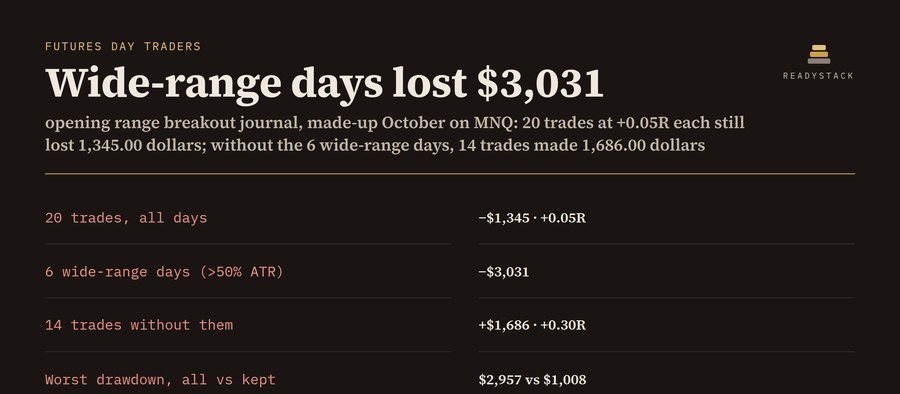
 opening range breakout journal — ES, NQ, MES, MNQ: net R after fees and range width vs ATR
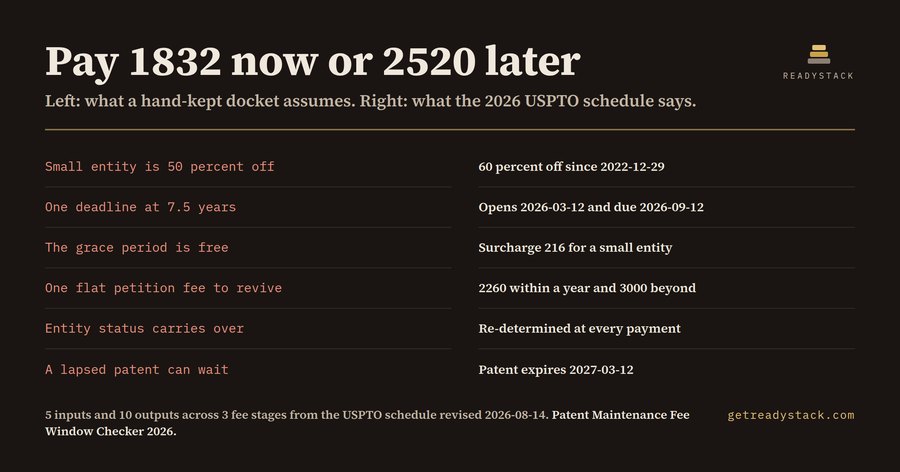 USPTO maintenance fee window and cost, 2026 schedule
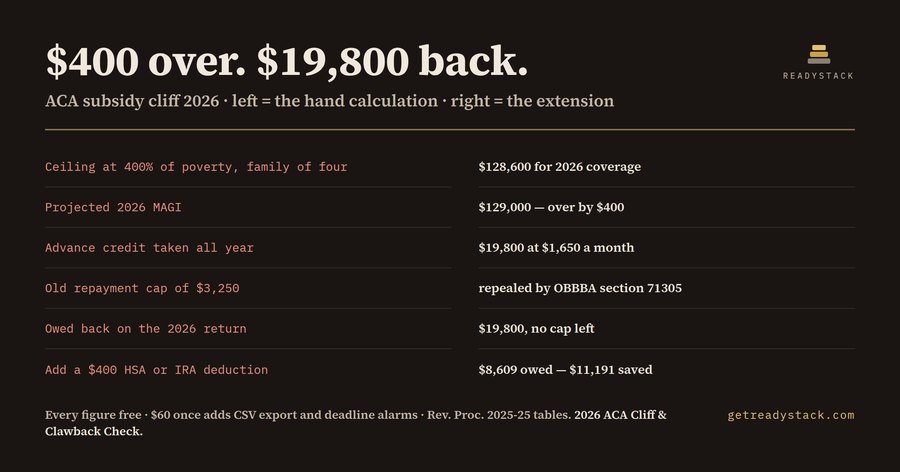 2026 ACA subsidy cliff and APTC repayment
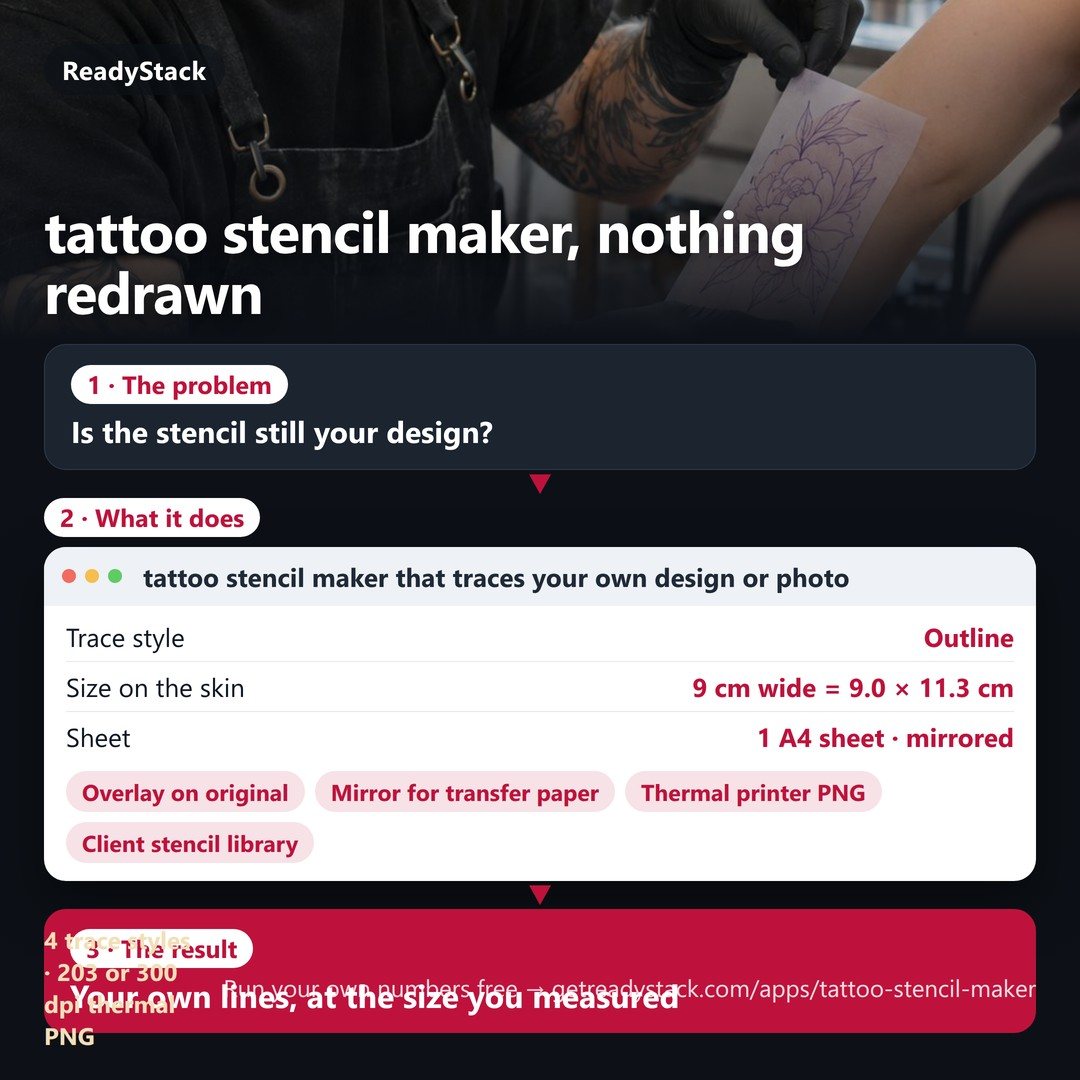 tattoo stencil maker: photo to lines, size, print and cost
 linkedin outreach tools: what one booked meeting costs you: invite limit, reply funnel, seat price and restriction loss